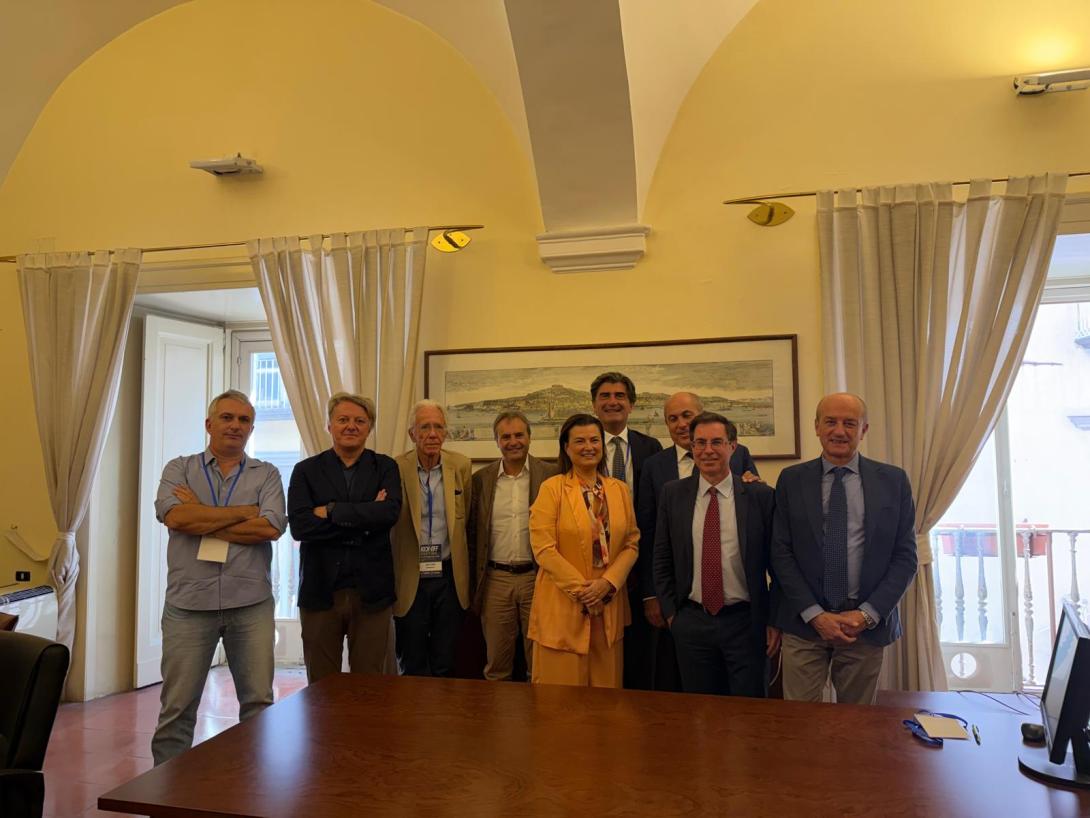
Università Iuav di Venezia has joined the RETURN Foundation – Multi-Risk sciEnce for resilienT commUnities undeR a changiNg climate, strengthening its commitment to the prevention and management of infrastructural and environmental risks and to the resilience of territories.
The membership was formalised on Wednesday 30 September 2026 in Naples, at the Università degli Studi di Napoli Federico II, the founding university that proposed the Foundation. The day forms part of the activities promoted by RETURN and coincides with the launch of new projects and initiatives dedicated to strengthening strategies for mitigating infrastructural, seismic, volcanic, environmental and climate risk.
RETURN is one of the leading national research partnerships dedicated to environmental, natural and man-made risks. Established within the framework of the PNRR – Mission 4, Component 2, Investment 1.3 – the partnership brings together universities, research bodies, public institutions and private entities with the aim of strengthening knowledge chains, developing innovative technologies and tools, and improving the country's capacity to prevent, understand and govern risk in a context marked by climate change.
There are over 30 academic and institutional partners, including Alma Mater Studiorum – Università di Bologna, Politecnico di Milano, Politecnico di Torino, Università di Palermo, Università di Firenze, Università di Genova, Università di Padova, Sapienza Università di Roma, Università di Cagliari, ENEA and OGS – National Institute of Oceanography and Experimental Geophysics.
On the institutional side, particularly significant partners include the Department of Civil Protection of the Presidency of the Council of Ministers, the Southern Apennines District Basin Authority, and Eurac Research/European Academy of Bolzano. Industrial and infrastructural partners include Ferrovie dello Stato Italiane, ENI Rewind, IREN, Engineering and Almaviva.
"Iuav's entry into the RETURN Foundation strengthens our ability to contribute, with a strongly interdisciplinary approach, to the challenges posed by the need to ensure safety and increase the resilience of the built environment," says Anna Saetta, Pro-Rector of Università Iuav di Venezia. "The growing exposure of territories to natural and man-made risks today requires integrating the assessment of the vulnerability of buildings and infrastructure, knowledge of materials and construction techniques, with the analysis of environmental impacts. Within this framework, Iuav can offer particularly advanced expertise on existing buildings, historical heritage and the built environment, contributing to the development of tools for risk prevention, monitoring and mitigation. RETURN therefore represents a strategic platform for turning scientific knowledge into design and operational solutions capable of increasing the safety and resilience of cities, infrastructure and territories."
Formal membership of the RETURN Foundation will allow Università Iuav di Venezia to bring together its expertise in the fields of territorial and urban planning, architecture, structural engineering, building safety, coastal area management, and risk reduction, including under conditions of climate crisis. This combination of expertise makes it possible to address the issue of resilience from an integrated perspective, from the scale of buildings and infrastructure to the urban and territorial scale.
"Joining RETURN represents an important step for Iuav in building an increasingly integrated national network on the themes of resilience and adaptation to climate change," states Francesco Musco, Research Director of Università Iuav di Venezia. "Climate and environmental risks cannot be addressed solely through sector-based responses: they require the ability to read and design the territory, integrating technological, design and policy-design knowledge. Iuav can bring to RETURN specific expertise on the relationship between climate transformations and spatial transformations, with particular attention to cities, coastal territories and the land-sea interface. For Venice, and more generally for the Adriatic area, this collaboration also takes on particularly significant value as an advanced laboratory for managing increasingly complex risk conditions, to which all the disciplines of analysis and design can contribute."