Date
Oct 1, 2026
Class
Comunicati stampa
Per saperne di più
Università Iuav di Venezia celebrates Ignazio Gardella (Milan 1905 – Oleggio 1999), one of the leading masters of twentieth-century Italian architecture, with the exhibition “Ignazio Gardella: Progettare la città” (Ignazio Gardella: Designing the City), organised as part of the Off programme for the celebrations of the University's Centenary.
After its first stage in Alessandria in 2025 – promoted for the 120th anniversary of the architect's birth – the exhibition arrives in Venice, highlighting the deep connection between Gardella and the Venetian university.
The exhibition is curated by Emanuele Piccardo (architecture critic and photographer) with the scientific advice of Sara Di Resta (professor of architectural restoration at Università Iuav di Venezia). It stems from the synergy between Università Iuav di Venezia, the Archivio Progetti Iuav and the Archivio Storico Gardella, and is promoted and organised by the Comune di Alessandria and ASM Costruire Insieme together with the cultural association plug_in. The exhibition also benefits from the collaboration of the Ordine degli Architetti PPC di Alessandria, Ance Alessandria and the Azienda Ospedaliero-Universitaria di Alessandria.
The architect's profile and his connection with Venice
A central figure of Italian rationalism, Gardella graduated in Engineering from the Politecnico di Milano in 1928 and in Architecture from Iuav in 1949, embodying the perfect synthesis of technical rigour and poetic vision. In 1955 he received the Olivetti Prize for Architecture for his ability to combine constructive essentiality, function and civic commitment.
His relationship with Venice and with Iuav was particularly intense. Called upon by Giuseppe Samonà, Gardella taught at the Venetian university from 1949 to 1975, taking part in 1952 in organising the CIAM International Summer School. Within the lagoon context, he designed one of the most emblematic post-war projects: Casa Cicogna (1953-1958) at the Zattere, a work at the centre of a lively critical debate, defended by figures such as Bruno Zevi and Giulio Carlo Argan. His contribution to Venice also extends to the works for the Hotel Excelsior at the Lido (with Roberto Menghi, 1963-1969) and for the Residence Albergo Gritti (1966-1969).
"Gardella's relationship with Venice began in 1949, when he graduated here in architecture, and lasted until 1975. On the centenary of Università Iuav di Venezia, it is significant to pay tribute to him," explains the curator, Emanuele Piccardo. "In Venice, the Milanese architect built Casa Cicogna, which represents his idea of the relationship between new and old. Gardella walked through the calli and studied the city, yet he was also somewhat in awe of it: 'Venice is a city I love very much... it is unique, fascinating and ever-changing, a city with which the relationship is immediately easy but never settles into something fixed... Now I believe that the relationship between old and new in historic centres must certainly be one of respect of the new towards the old, but not one of mimetic subjection.' In this sense, his house at the Zattere, built in 1958, does not blend in. Indeed, the house has its own autonomous language, and the elements of Venetian architecture are reinterpreted," explains Emanuele Piccardo, "the white stone of Vicenza, similar to the Dalmatian stone of Orsera used for Venetian palazzi, the plaster made with brick dust, and the frames around the windows. But the relationship with Venice is also, and above all, linked to his teaching at Iuav. There, together with Albini, he coordinated the CIAM summer school and taught design to the architects of the future. On the design front, meanwhile, he worked on the layout of the entrance and bar of the Hotel Excelsior at the Lido, together with Roberto Menghi, but he also designed the beach huts on the adjacent shore, demonstrating his versatility as a designer. He also designed the Apartment House of Palazzo del Giglio and the Residence del Gritti."
"The exhibition," comments Sara Di Resta, scientific advisor for the exhibition and Iuav lecturer, "offers a critical examination of the work of Ignazio Gardella, raising pressing questions related to the fragility of twentieth-century architectural heritage. The interweaving of archival research and photographic investigation provides valuable elements for launching a hoped-for shared path between research and institutions aimed at safeguarding an exceptional and complex heritage, to be handed down to the future."
The exhibition itinerary
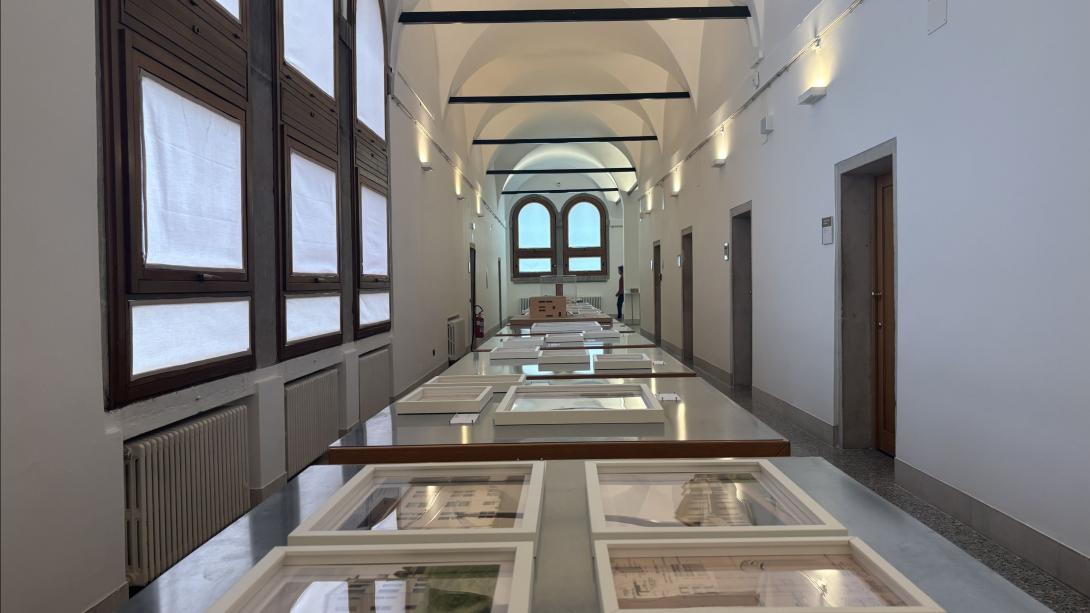
The itinerary brings together archival documents, photographs, drawings and sketches alongside a photographic campaign carried out specifically for the exhibition by Marco Introini and Emanuele Piccardo, and examines nine projects signed by Ignazio Gardella across Alessandria, Milan, Genoa and Venice.
The aim is to show the Milanese architect's ability to "design the city" through buildings conceived as urban fragments in dialogue with the existing fabric – a fundamental moment also for the evolution of Gardella's later projects.
The exhibition is organised into four sections:
The Alessandria lesson: focused on his early works and on masterpieces of rationalism such as the Dispensario Antitubercolare (1933-1938) and the Case per impiegati Borsalino (1948-1952), whose influence extends to the projects for the INA-Casa terraced houses and the church of Cesate.
The relationship with the historic centre (Genoa): focused on urban projects including the Detailed Plan for San Donato and San Silvestro (1969-1976) and the Faculty of Architecture (1975-1989).
The Venetian experience: an in-depth section dedicated to Casa Cicogna, to the projects for the Lido, and to the documents from the Archivio Progetti Iuav relating to Gardella's teaching activity and to the inaugural lectures he delivered in the 1950s.
The photographic narrative: a visual investigation curated by Marco Introini, which reinterprets Gardella's architecture, highlighting its urban, poetic and constructive dimension.
The exhibition was made possible thanks to the loan of models and archival materials held by the Archivio Progetti Iuav, the Archivio Storico Gardella and the CSAC – Centro Studi e Archivio della Comunicazione of the Università di Parma.
The Venetian stage of the exhibition was realised thanks to the valuable collaboration with the Archivio Progetti Iuav, which loaned the period models of the Case per impiegati Borsalino and the Dispensario Antitubercolare; the Archivio Storico Gardella, which holds original documents, letters, interviews and project materials; and the CSAC – Centro Studi e Archivio della Comunicazione of the Università di Parma, which preserves the Gardella collection.
The publication
The first outcome of the exhibition is the volume "Ignazio Gardella, Progettare la città", published in 2025, edited by Emanuele Piccardo, which brings together contributions by Luca Guido, Gregorio Carboni Maestri, Roberto Livraghi, Andrea Vergano, Angelo Lorenzi, Claudia Cavallo and Pierluigi Serraino, together with a previously unpublished body of archival material.