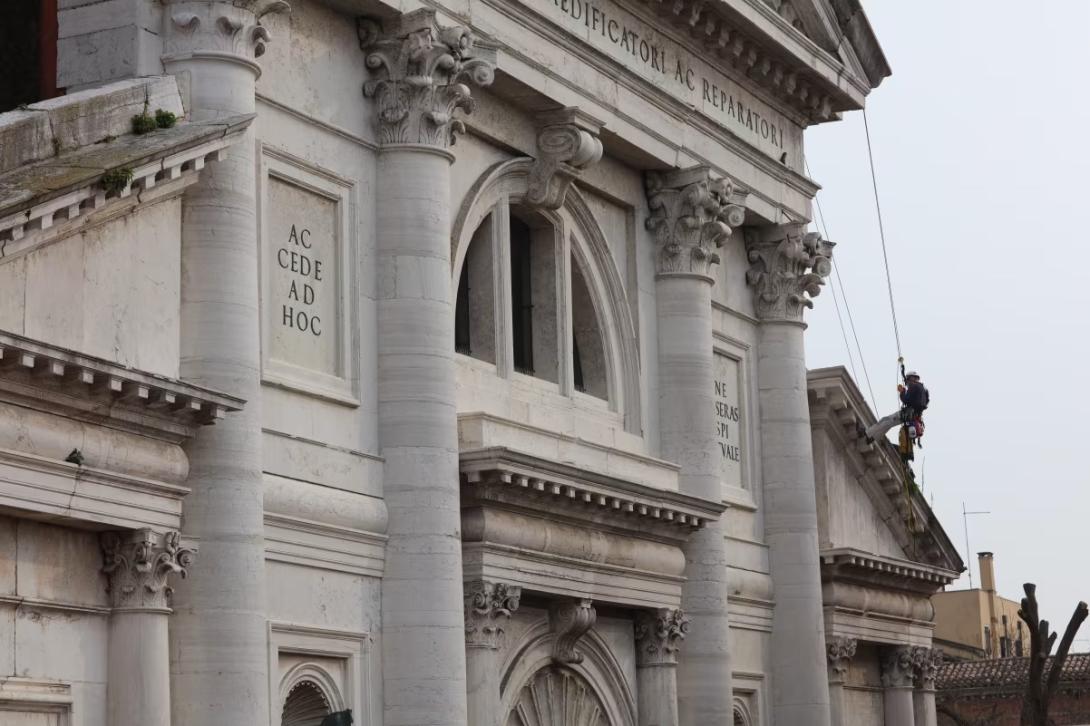
CNN Science has published an article by Radina Gigova on the digital technologies used to document and protect Venice’s architectural heritage. The piece devotes considerable space to the survey and monitoring project at the church of San Francesco della Vigna, developed with the contribution of academic staff and researchers of Università Iuav di Venezia.
The project, launched in 2023, is led by architect Ilaria Forti, who also teaches in the restoration, survey and digital drawing laboratory at Iuav. Drone photography and terrestrial laser scanning were combined with archival research and structural analysis to build a three-dimensional model of the church and a digital twin, useful for identifying vulnerable areas and guiding future conservation work. The work was requested by the order of Franciscan friars and supported by the Venice in Peril Fund.
The collaboration with Università Iuav di Venezia began after the restoration of the façade of the church of Santa Maria di Nazareth, directed by Forti from 2015 to 2022, when a monitoring programme was launched together with the VIDE Lab, directed by Giuseppe D’Acunto. Irene Rocca, postdoctoral research associate and engineer who worked at the laboratory, built with the team the finite element model used for the structural analysis. Under the supervision of Anna Saetta, Deputy rector of Università Iuav di Venezia, she examined in particular the bronze statue of Moses by Tiziano Aspetti, identifying a concentration of stress around the ankle, within the material’s strength limits. Gabriella Liva, a scholar of statuary at Iuav’s LAR Lab, also contributed to reconstructing the geometry of the statues of Moses and St Paul.
The article also reports the assessments of experts external to the project, including Luigi La Rocca, head of the Department for the Protection of Cultural Heritage (DiT) at the Ministry of Culture, Debra Laefer of New York University and Aylin Orbasli of Oxford Brookes University, and addresses the limits of these technologies, such as costs, data management and the need for direct checks on site. Among the goals indicated by the researchers is the possibility of integrating new data into the model over time, so that those responsible for conservation in the future can build on the work already completed. “In conservation, I think it’s important not to start every time from zero,” observes Rocca.
Photo by Francesca Zamengo